
Do you ever feel like your brain has too many browser tabs open?
I know the feeling well. You sit down to write an email, but within seconds, you’re checking a text message, scrolling through Instagram, and eating a sandwich—all while believing you are being incredibly productive.
But here is the hard truth that took me years to accept: multitasking is a myth.
We wear our “busyness” like a badge of honor. We think juggling three tasks simultaneously makes us efficient super-humans. But in reality, this habit is silently sabotaging our cognitive health, increasing our anxiety, and killing our ability to do meaningful work.
If you end your days feeling drained but unaccomplished, you aren’t lazy. You are likely a victim of the “switch cost” effect.
In this Life Record post, I’m going to share the psychology behind why your brain cannot multitask, and the specific deep work strategies I used to go from scattered to laser-focused.
Table of Contents
The Science: Why Your Brain Can’t Multitask
Many of us believe we are the exception to the rule. We think, “Sure, other people can’t do two things at once, but I’m good at it.”
Neuroscience begs to differ.
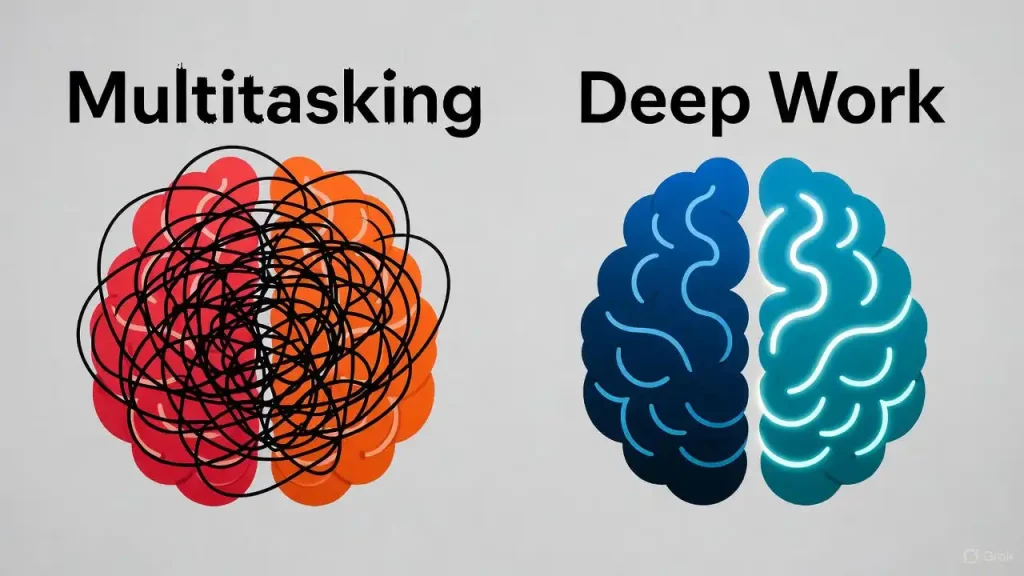
When you think you are multitasking, you are actually doing something called rapid task switching. The human brain, specifically the prefrontal cortex, is not wired to process two cognitively demanding tasks simultaneously. It is like a computer with a single processor core; it can only run one code at a time.
Here is what actually happens:
- Stop: You disengage from Task A.
- Switch: Your brain shifts rules and context.
- Start: You engage with Task B.
This happens in a fraction of a second, which gives the illusion of parallelism. But this constant stop-start mechanism is exhausting for your brain.
Did You Know? A study conducted at Stanford University found that heavy multitaskers were actually worse at filtering out irrelevant information and switching tasks than those who rarely multitask.
It Lowers Your IQ
It sounds harsh, but the data is alarming. Research suggests that constant multitasking can temporarily lower your IQ by up to 15 points. That is roughly the equivalent of pulling an all-nighter or smoking marijuana while working.
Once we accept that multitasking is a myth, we can stop fighting our biology and start working with it.
The Hidden Cost of “Task Switching”
The biggest enemy of productivity isn’t laziness; it’s Attention Residue.
This concept, highlighted by computer science professor Cal Newport in his book Deep Work, explains why you feel so scattered. When you switch from writing a report to checking Slack, your attention doesn’t immediately follow.
A “residue” of your attention remains stuck thinking about the previous task.
The “Switch Cost” Effect
Every time you switch contexts, you pay a “tax” on your energy.
- Time Loss: It takes an average of 23 minutes to get back into the zone after a distraction.
- Error Rate: Multitasking increases error rates by up to 50%.
- Cortisol Spike: Constant switching puts your brain in a state of low-level “fight or flight,” increasing stress and anxiety.
Read Also The Fallacy of Multitasking
If you check your email every 10 minutes, you are essentially forcing your brain to pay this tax repeatedly. By noon, you are mentally bankrupt.
Life Record: My Battle With the Distraction Economy
I want to get personal for a moment. Three years ago, I hit a wall.
I was working as a freelance editor, managing this SoulDairy blog, and trying to launch a podcast. My workspace was a disaster of sticky notes, and my browser looked like a deck of cards with 40 open tabs.
I would write a sentence, check Twitter, reply to a text, and then try to remember what I was writing.
The result?
- I felt constantly anxious.
- My work quality dropped.
- I couldn’t remember conversations I had with my partner just hours before.
I realized I wasn’t “hustling.” I was hiding. I was using busyness to avoid the difficult, scary work of sitting still with my own thoughts.
Admitting that multitasking is a myth was my first step toward recovery. I had to detox my brain. It wasn’t easy—in fact, the first week of “single-tasking” felt agonizingly boring. But slowly, the fog lifted.
Key Takeaway: Busyness is not the same as productivity. You can be moving at 100mph but going in circles.

What is Deep Work? (And Why You Need It)
If multitasking is the disease, Deep Work is the cure.
Deep Work is the ability to focus without distraction on a cognitively demanding task. It is a skill that allows you to quickly master complicated information and produce better results in less time.
In our distracted world, this ability is becoming increasingly rare—and therefore, increasingly valuable.
The Benefits of Going Deep:
- Higher Quality Output: You solve complex problems faster.
- Mental Clarity: You finish the day with energy left over.
- True Satisfaction: There is a unique dopamine release that comes from completing a difficult task well (often called the “Flow State”).
Read Also : 10 Essential Productivity Tools for Entrepreneurs to Scale Fast (2025)
7 Actionable Steps to Cultivate Deep Work
Knowing that multitasking is a myth is one thing; changing your habits is another. Here are the 7 steps I used to reclaim my focus.
1. Embrace the “One Tab” Rule
This is simple but painful. When you are working on a task, close every other browser tab. If you need to research, open a window specifically for research, then close it.
- Why it works: It removes visual cues that trigger the urge to switch tasks.
2. Schedule “Deep Work” Blocks
Don’t wait for inspiration. Schedule focus like you schedule a dentist appointment.
- Start small: Aim for 90 minutes of uninterrupted work first thing in the morning.
- Treat this time as sacred. No phones, no emails, no “quick questions.”
3. The Phone Fasts
Your phone is a slot machine designed to steal your attention.
- The Strategy: Put your phone in another room while working. Not just face down—physically away. “Out of sight, out of mind” is scientifically proven to reduce cognitive load.
4. Ritualize Your Start
Your brain loves cues. Create a ritual that signals “It is time to focus.”
- Make a specific cup of tea.
- Put on noise-canceling headphones.
- Light a candle. Over time, these physical actions will trigger a mental shift into deep work.
5. Practice “Productive Meditation”
This is a technique I love. Take a walk (without a podcast!) and focus your mind on a single professional problem. When your mind wanders, gently bring it back to the problem. This strengthens your “focus muscles.”
6. Batch Your “Shallow Work”
We all have emails to answer and admin to do. Don’t let them bleed into your day.
- The Fix: Schedule 1 hour at the end of the day to blitz through all emails, Slack messages, and phone calls at once.
7. Embrace Boredom
This is the hardest one. We are terrified of boredom, so we fill every gap (waiting in line, elevator rides) with our phones.
- Try this: Let yourself be bored. It resets your dopamine receptors and teaches your brain that it doesn’t need constant stimulation.
Read Also Souldairy Post : 7 Bad Habits Killing Productivity You Must Break
Pro Tips for Success
- The 20-Minute Rule: If you feel the urge to quit a hard task, force yourself to wait 20 minutes. Usually, the urge passes.
- Binaural Beats: Try listening to “Focus” playlists or 40Hz binaural beats to help synchronize your brainwaves.
- Forgive Yourself: You will fail. You will check Instagram. That’s okay. Just gently return to the task.
Focus Audit: A Quick Reflection
Before you scroll down, take a pen and paper (analog is best!) and answer these three questions honestly:
- What is the one distraction that interrupts me most often? (e.g., Slack, Phone, Hunger)
- At what time of day do I feel most mentally alert?
- What is one “deep” task I have been putting off because I’m “too busy”?
Your answers here are your roadmap to better focus.
Frequently Asked Questions
Is listening to music considered multitasking?
It depends. Instrumental music can actually aid focus by blocking out background noise. However, music with lyrics engages the language center of your brain, which is a form of multitasking if you are trying to write or read.
I have ADHD. Can I still learn Deep Work?
Absolutely. While the multitasking is a myth concept applies to everyone, ADHD brains may struggle more with impulse control. Strategies like the Pomodoro technique (25 minutes work, 5 minutes break) are often highly effective for neurodivergent minds.
What if my boss expects me to answer emails instantly?
This is a common culture problem. Try communicating a “focus block” schedule to your team. Say, “I will be offline from 9 AM to 11 AM to finish the project report.” Most employers prefer results over instant responsiveness.
How long does it take to break the multitasking habit?
Psychology suggests it takes about 66 days to form a new habit. Be patient. Your brain is plastic; it can be retrained, but it requires consistency.
Can multitasking ever be good?
Only if one task is automatic. You can walk (automatic) and talk (cognitive) at the same time. You can fold laundry (automatic) and listen to a podcast (cognitive). But two cognitive tasks? Never.
Conclusion
The evidence is clear: multitasking is a myth.
It is a comfortable lie we tell ourselves to avoid the discomfort of focusing on one hard thing. But you are capable of so much more than shallow, scattered work.
By slowing down, single-tasking, and protecting your attention, you won’t just get more done—you will enjoy the process of living again. You will remember conversations. You will feel proud of your work. You will find your soul in the daily dairy of life.
I’d love to hear from you. Which of the 7 steps feels most difficult for you to implement? Do you struggle with “Phone separation anxiety”? Let me know in the comments below!