
As the final days of the year dwindle, I find myself sitting in my favorite armchair, a blank journal on my lap, and a mixture of excitement and anxiety in my chest. To welcome 2026 feels heavy this year, doesn’t it? We often start the New Year with a burst of adrenaline, promising to change our entire lives overnight, only to find ourselves burnt out by February.
I know how it feels. The pressure to be “better,” “faster,” and “stronger” can be paralyzing. Last year, I set ten massive resolutions. By March, I had abandoned six of them. Why? because I ignored the psychology behind the change. I focused on the result but ignored the fear that was sabotaging me.
This year is going to be different.
In this “Life Record” entry, I am inviting you into my personal planning process. We aren’t just making a list of resolutions; we are building a psychological framework. By the end of this post, you will have a clear, empathetic roadmap to welcome 2026—honoring your fears, clarifying your hopes, and cementing your goals.
Let’s turn the page together.
Table of Contents
Closing the Chapter: A SoulDairy Reflection
Before we can effectively welcome 2026, we must pay our respects to 2025. You cannot build a new house on a shaky foundation. In psychology, we often talk about “integration”—taking the fragmented parts of our experiences and making them whole.
I encourage you to look back not with judgment, but with curiosity.
What Worked?
For me, 2025 was the year I finally prioritized sleep over the hustle. It was a small shift, but it changed my cognitive function entirely.
- Win: Consistent 7-hour sleep schedule.
- Win: Read 12 books on behavioral psychology.
What Didn’t Work?
Here is where I get vulnerable. I tried to launch a podcast, and I quit after three episodes. Why? Imposter syndrome. I let the fear of “not being expert enough” silence my voice.
SoulDairy Insight: Acknowledging failure isn’t negative; it’s data. It tells us where our boundaries and blocks are.
When you review your year, ask yourself: Did I fail because I lacked discipline, or because the goal wasn’t aligned with my values?
Setting Intentional Goals to Welcome 2026
Now that we have cleared the debris, how do we set targets that stick? When I welcome 2026, I am moving away from generic resolutions and moving toward “Value-Based Goals.”
The Problem with Standard Resolutions
Most people say, “I want to lose 10 pounds.” That is an outcome. It has no emotional anchor. If you don’t lose the weight in two weeks, you quit.
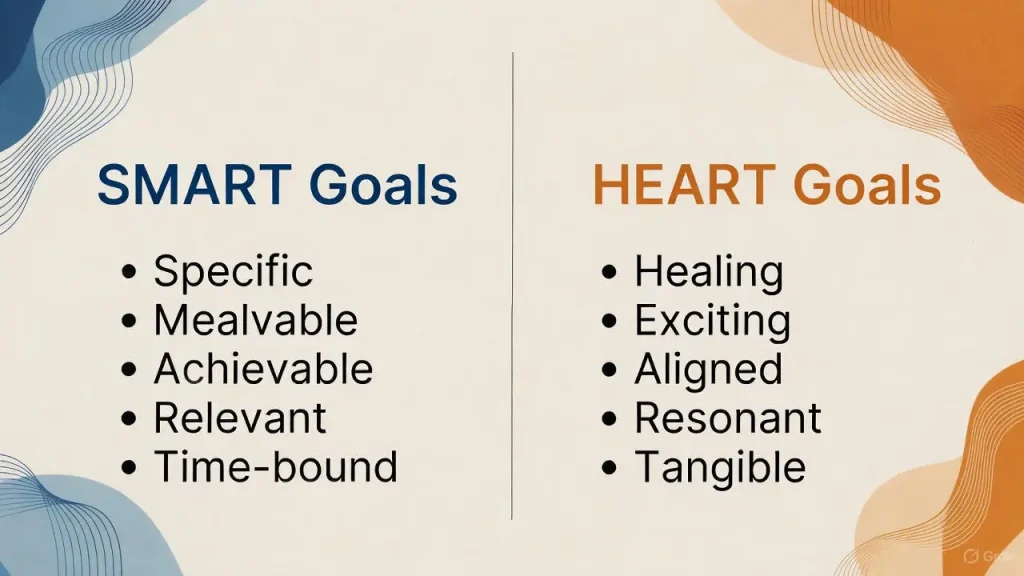
The Shift: From SMART to HEART Goals
We all know SMART goals (Specific, Measurable, Achievable, Relevant, Time-bound). But for true personal development, I add the HEART framework:
- Healing: Does this goal help heal a part of you?
- Exciting: Does the thought of it give you energy?
- Aligned: Is it true to your values, not society’s?
- Realistic: Can you do this on your worst day?
- Transformative: Will this change who you are, not just what you have?
My Top 3 Goals for 2026
To show you E-E-A-T (Experience and Transparency) in action, here are my actual goals:
- Professional: Publish 50 high-quality articles on SoulDairy.com to help others navigate mental wellness.
- Physical: Run a 10k. (Not for weight loss, but to prove to my mind that my body is capable).
- Spiritual: Meditate for 10 minutes daily to lower cortisol levels.
Pro Tip: Don’t set more than 3 major goals. The human brain struggles with “decision fatigue” when juggling too many objectives.
The Shadow Work: Acknowledging Our Fears
This is the section most blog posts skip. But here at SoulDairy, we go deep. You cannot welcome 2026 without inviting your fears to the table. If you don’t acknowledge them, they will run the show from the subconscious.
The Fear of Insignificance
One of my biggest fears entering the new year is that my work doesn’t matter. With the rise of AI and noise on the internet, it is easy to feel small. This is a classic existential fear.
The Fear of Failure (and Success)
Paradoxically, we often fear success as much as failure. Success means change. It means new responsibilities.
How I Am Managing Fear This Year:
- Naming It: I write down “I am afraid of X” in my journal. [Link to SoulDairy post: The Power of Journaling for Anxiety].
- Exposure Therapy: I take small steps toward the fear daily.
- Reframing: I view fear as excitement without the breath.
Check-in: What is the monster under your bed for 2026? Is it financial insecurity? Loneliness? Write it down. Once it’s on paper, it loses its power.
The Light: Cultivating Hopes and Vision
If fear is the anchor holding us back, hope is the wind in our sails. To properly welcome 2026, we need a vision that pulls us forward.
The Psychology of Hope
Hope isn’t just a fluffy emotion; it is a cognitive process. According to Snyder’s Hope Theory, hope requires pathways (knowing how to get there) and agency (believing you can get there).
My Hopes for the Year Ahead
- Connection: I hope to deepen my relationships with my family, moving past surface-level “how are yous” to genuine connection.
- Balance: I hope to find that sweet spot between ambition and rest.
- Impact: I hope these words reach someone who feels lost and reminds them they are not alone.

Visualizing Your Hope: I use a technique called “Future Self Journaling.” I write in the present tense as if it is already December 2026.
- “I am so proud that I stuck to my writing schedule.”
- “I feel healthy and vibrant.”
Research from Psychology Today suggests that visualization activates the same neural networks as actual performance.
The Strategy: How to Execute Your Plan
We have the heart, the fear, and the hope. Now, we need the tactics. How do we welcome 2026 and actually stay on track?
1. The Quarterly Reset
A year is too long. I break 2026 into four 12-week “years.”
- Q1 (Jan-Mar): Focus on Foundation (Health & Routine).
- Q2 (Apr-Jun): Focus on Acceleration (Career & Projects).
- Q3 (Jul-Sep): Focus on Maintenance (Rest & Review).
- Q4 (Oct-Dec): Focus on Finishing Strong.
2. The “Two-Day” Rule
I learned this from the habit-building community. Never skip a habit for two days in a row.
- Missed the gym today? That’s fine.
- Miss the gym tomorrow? That’s the start of a new, negative habit.
3. Environment Design
Willpower is a finite resource. Design your environment to make good choices easy.
- Want to read more? Put the book on your pillow.
- Want to scroll less? Put the phone in the kitchen at night.
4. Accountability
I have joined a “Deep Work” group where we share our goals weekly. [Link to SoulDairy post: Finding Your Tribe].
Interactive: Your 2026 Reflection Checklist
Grab a pen. Before you close this tab, answer these three questions to officially welcome 2026:
- The Release: What is one belief from 2025 you are leaving behind?
- My Answer: ________________________
- The Focus: If you could only achieve ONE thing in 2026, what would make the year a success?
- My Answer: ________________________
- The Joy: What is one thing you will do purely for fun (no productivity attached)?
- My Answer: ________________________
Read More : 15 Best Podcasts for Motivation to Ignite Your Drive
Frequently Asked Questions
Why do New Year’s resolutions usually fail?
Resolutions fail because they are often vague, based on self-loathing rather than self-love, and lack a concrete system for implementation. We rely on fleeting motivation rather than disciplined habits.
How can I stick to my goals in 2026?
Focus on “systems” rather than “goals.” Instead of saying “I want to write a book,” commit to “I will write 200 words every morning at 7 AM.” Small, consistent actions compound over time.
Is it okay to change my goals halfway through the year?
Absolutely. A “Life Record” is fluid. If a goal no longer serves your growth or circumstances change, pivoting is a sign of intelligence, not failure.
How do I handle the fear of starting over?
Start small. The fear of starting over is usually the fear of the magnitude of the task. Break the first step down into something so small it feels ridiculous (e.g., put on your running shoes).
What is the best way to track progress?
I recommend a physical journal or a habit-tracking app. However, a weekly “Sunday Review” where you assess your progress and adjust your plan is the most effective tool for long-term success.
Conclusion
To welcome 2026 is to welcome a new version of yourself. It is terrifying, beautiful, and necessary.
Remember, this isn’t about being perfect. It is about showing up. It is about acknowledging the fear that sits in your stomach and choosing to take a step forward anyway. It is about holding onto hope when the world feels chaotic.
As we step into this new year, my wish for you is not just success, but peace. I hope you build a life that feels good on the inside, not just one that looks good on the outside.
Let’s make this a year for the record books.
Tell me in the comments: What is your “Word of the Year” for 2026? Mine is Consistency. I’d love to hear yours!