
Does the thought of asking for more money make your palms sweat and your heart race? I know that feeling all too well.
I remember my first “real” job review. I had exceeded every KPI, yet I sat in the parking lot for twenty minutes beforehand, hyperventilating. I was terrified of conflict, afraid of seeming greedy, and convinced that if I just worked hard, they would notice. (Spoiler: They didn’t).
If you are an introvert, the loud, aggressive style of negotiation often portrayed in movies feels alien—and frankly, nauseating. But here is the truth: Salary negotiation for introverts doesn’t require you to become a loud extrovert. In fact, your natural traits—deep listening, preparation, and empathy—might actually make you better at it than your louder counterparts.
In this “Life Record” guide, we are going to dismantle the fear. You will walk away with a roadmap to earn your worth without compromising your authentic self.
Table of Contents
Why Introverts Are Secretly Negotiation Powerhouses
There is a misconception that negotiation requires table-banging and fast-talking sales tactics. That is the “Wolf of Wall Street” method, and it rarely works in modern, collaborative work environments.
Effective negotiation is actually about information gathering and problem-solving.
Here is why your introverted nature is an asset:
- We Listen More Than We Speak: While extroverts are planning their next sentence, you are absorbing data. This helps you understand the other party’s constraints.
- We Are Obsessive Preparers: You aren’t likely to “wing it.” You will walk in with facts, data, and receipts.
- We Are Empathetic: You can read the room, ensuring the conversation remains constructive rather than combative.
SoulDairy Note: Don’t try to change your personality. Lean into it. Authentic quiet confidence is incredibly persuasive.
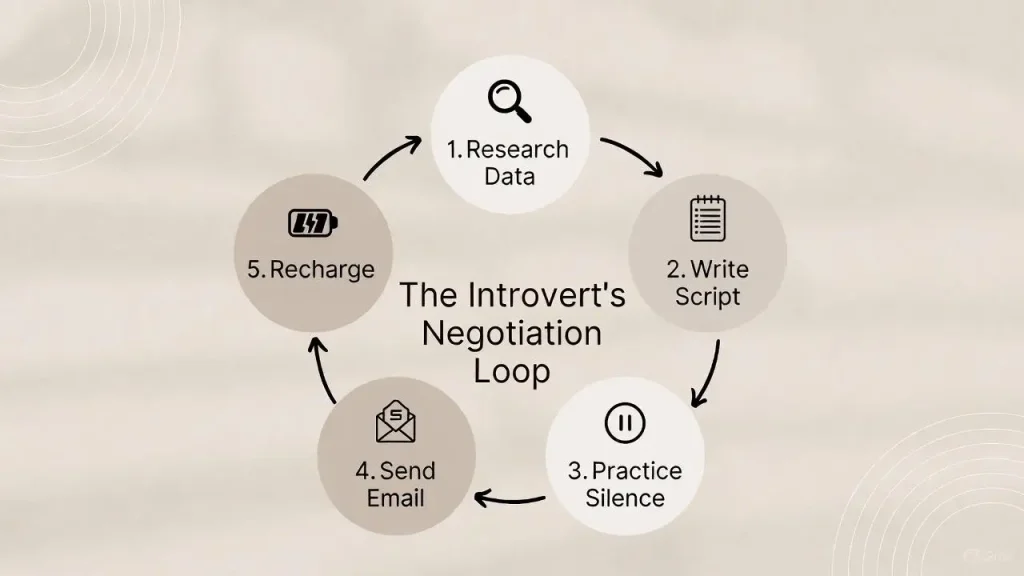
Step 1: The “Deep Dive” Preparation Method
Anxiety usually stems from the unknown. As introverts, we find comfort in data. Use that desire for certainty to build an unshakeable case.
Know Your Market Value
You cannot negotiate based on what you need (rent, bills); you must negotiate based on what the market pays.
- Use Aggregators: Check Glassdoor, Payscale, and LinkedIn Salary for your specific role and location.
- Network Quietly: You don’t have to go to a mixer. Reach out to a trusted mentor or peer via LinkedIn messaging to ask for a salary range for your level of experience. [Link to relevant SoulDairy post: How to Network Without Burning Out].
The “Brag Sheet”
Introverts often struggle with self-promotion. To counter this, create a “Brag Sheet” well before the meeting. List every accomplishment, compliment from a client, and metric you have improved.
Pro Tip: Quantify everything. Instead of “I improved efficiency,” write “I reduced processing time by 20%, saving the team 5 hours a week.”
Step 2: Scripting Your Success (So You Don’t Freeze)
The biggest fear for many of us is “going blank” when put on the spot. The solution? Scripts.
I literally write out my opening sentences on a notepad and bring it with me. It’s not cheating; it’s being professional.
The “I Value the Team” Opener
Start with gratitude. It lowers your cortisol and disarms your manager.
“I’ve really enjoyed the challenges of this past year, specifically [Project X]. I’m fully committed to the team’s success. Based on my recent performance and market research, I’d like to discuss adjusting my salary to reflect the current market value for this role.”
The “Data-Backed” Ask
“According to my research, the market rate for a Senior Editor with my experience is between $75,000 and $85,000. Given that I’ve taken on [Task A] and [Task B] this year, I’m looking to move my base salary to $82,000.”
Having these words written down ensures that even if your nerves spike, your message remains clear.
Psychology Today – The Psychology of Scripting
Step 3: The Power of the “Awkward Pause”
This is my favorite tip for salary negotiation for introverts.
In a negotiation, silence is heavy. Extroverts often rush to fill silence because it feels uncomfortable. If you make your request and then stop talking, the other person feels a psychological pressure to fill that void—often by conceding or offering more information.
How to do it:
- State your number.
- Stop.
- Count to five in your head.
- Maintain eye contact (softly) or look at your notes.
If you ramble (“…but I know budgets are tight, and if that’s too much, I understand…”), you negotiate against yourself. Say the number, then embrace the silence.
Step 4: Leveraging Written Communication
Who says the entire negotiation has to happen verbally?
If you are an introvert, you likely express yourself better in writing. You can take your time to choose the perfect words without the pressure of a staring face.
The Hybrid Approach
Use the meeting to start the conversation, but move the details to email.
The Strategy:
- Have a brief meeting to state your intent to review compensation.
- Follow up immediately with a detailed email attaching your “Brag Sheet” and market research.
- “I’ve summarized our discussion and attached the data regarding my recent performance and market rates. I’d love for you to review this before our next chat.”
This allows you to make your strongest case in your strongest medium.
Read Also : 15 Best Books on Leadership Every Manager Must Read
Step 5: Managing the Energy Drain
Negotiation is socially expensive for introverts. It drains our battery.
I once finished a negotiation, got the raise, and then immediately went home and slept for three hours. That is okay.
Self-Care Protocol for Negotiation Day:
- Schedule Wisely: Do not schedule the meeting back-to-back with other high-stress events.
- Visualise: Spend 5 minutes visualizing a positive outcome, not the conflict.
- The Power Pose: It sounds cheesy, but standing in a “Superman” pose for 2 minutes in the bathroom before the meeting actually changes your body chemistry, reducing cortisol and increasing testosterone (confidence).
🛑 Interactive: Your Pre-Negotiation Confidence Checklist
Before you send that calendar invite, check these boxes. If you can’t check them all, you aren’t ready yet.
- [ ] I have researched the market rate for my role in my specific city.
- [ ] I have a written list of my top 5 accomplishments from the last year.
- [ ] I have practiced saying my “Ask Number” out loud in front of a mirror until I didn’t giggle or cringe.
- [ ] I have a “Plan B” (e.g., if they can’t offer money, can they offer more vacation time or remote work?).
- [ ] I have scheduled 30 minutes of “quiet time” immediately after the meeting to decompress.
Frequently Asked Questions (FAQ)
1. What if they say “No” immediately?
Don’t panic. A “no” is often just the start of the negotiation. Ask “Why?” (gently). Is it budget? Performance? Timing? Ask: “What would need to happen for us to revisit this in 3 months?” This turns a rejection into a future plan.
2. Is it rude to negotiate salary via email?
It is generally better to start the conversation face-to-face (or video) to build rapport, but it is perfectly acceptable to handle the specifics, data sharing, and counter-offers via email. It gives you a paper trail, which is crucial.
3. How much of a raise should I ask for?
Standard annual raises are 3-5%. For a promotion or market adjustment, 10-20% is common. Always ask for slightly more than you want (e.g., if you want $80k, ask for $85k) to leave room for compromise.
4. I feel guilty asking for more money. How do I stop?
Remember: Employment is a business transaction. You provide value; they provide compensation. You are not asking for a favor; you are asking for a market correction. Healthline – Overcoming Imposter Syndrome.
5. What if I cry during the meeting?
It happens. I have been there. Take a deep breath. Say, “I’m very passionate about my contribution here, so I’m feeling a bit emotional. Let me take a sip of water.” It shows you care, not that you are weak.

Conclusion
Negotiating your salary as an introvert doesn’t mean you have to act like someone else. You don’t need to be the loudest voice in the room to be the most effective one.
By preparing deeply, using scripts, and leveraging your natural ability to listen and analyze, you can navigate these conversations with grace and strength. Remember, your employer hired you because they value you—your skills, your mind, and yes, even your quiet nature. It is time your paycheck reflected that value.
What is your biggest fear when it comes to talking about money? Drop a comment below—I read every single one, and we can support each other through it!