

Introduction
Starting a journal can feel overwhelming. How to start journaling for beginners is a question I once asked myself when I stared at a blank page, unsure what to write.
I know how it feels to want clarity, peace, and self-discovery but struggle to begin. The problem is not journaling itself—it’s the fear of doing it “wrong.” That hesitation keeps many people from experiencing the life-changing benefits of journaling.
Here’s the truth: there is no wrong way to journal. By the end of this guide, you’ll have practical steps, prompts, and routines to start journaling confidently—even if you’ve never written a single line before.
Table of Contents
Why Journaling Matters
Journaling is more than writing—it’s a mirror for your mind. Studies show that journaling reduces stress, improves memory, and strengthens emotional resilience (psychologytoday).
When I began journaling, I noticed how my scattered thoughts became clearer. Writing gave me space to breathe, reflect, and grow.
Step 1: Choose Your Journal
Paper or Digital?
- Notebook: Classic, tactile, helps memory.
- Digital App: Convenient, searchable, portable.
I started with a simple notebook from a local store. The feel of pen on paper made me slow down and reflect.
Step 2: Set a Journaling Intention
Ask yourself: Why am I journaling?
- To reduce stress?
- To track habits?
- To explore emotions?
Your intention guides your practice. Mine was simple: “I want to understand myself better.”
Step 3: Create a Simple Routine
Consistency matters more than length.
- Morning pages: Write 5 minutes after waking.
- Evening reflection: Note 3 things you learned today.
I began with 10 minutes before bed. It became my ritual of closure.
Step 4: Start Small with Prompts
One of the most effective journaling tips for beginners is to use simple prompts like
- “Today I feel…”
- “One thing I’m grateful for is…”
- “If I could change one thing, it would be…”
Read Relevent Souldairy Post..
Step 5: Focus on Feelings, Not Grammar
Your journal is not an essay. Forget spelling, grammar, or structure. Write raw. Write real.
I once scribbled half sentences and doodles. That messy page was more healing than a polished one.
Step 6: Experiment with Styles
- Gratitude journaling
- Bullet journaling
- Stream-of-consciousness writing
- Goal tracking
Try each style for a week. Notice which feels natural.
Step 7: Use Journaling for Stress Relief

Writing down worries externalizes them. It’s like putting heavy bags down after carrying them all day.
I often write letters I never send. It clears emotional clutter.
Step 8: Track Your Growth
Revisit old entries monthly. Highlight patterns. Celebrate progress.
I smiled when I saw how my “bad days” became less frequent over time.
Step 9: Overcome Common Blocks
- No time? Write 3 lines.
- No ideas? Use prompts.
- Fear of judgment? Keep it private.
Read: Digital Journaling vs Paper Diary
Step 10: Make Journaling a Lifelong Habit
Journaling is not a one-time project. It’s a lifelong companion.
Think of it as your personal archive—a “life record” of growth, lessons, and memories.
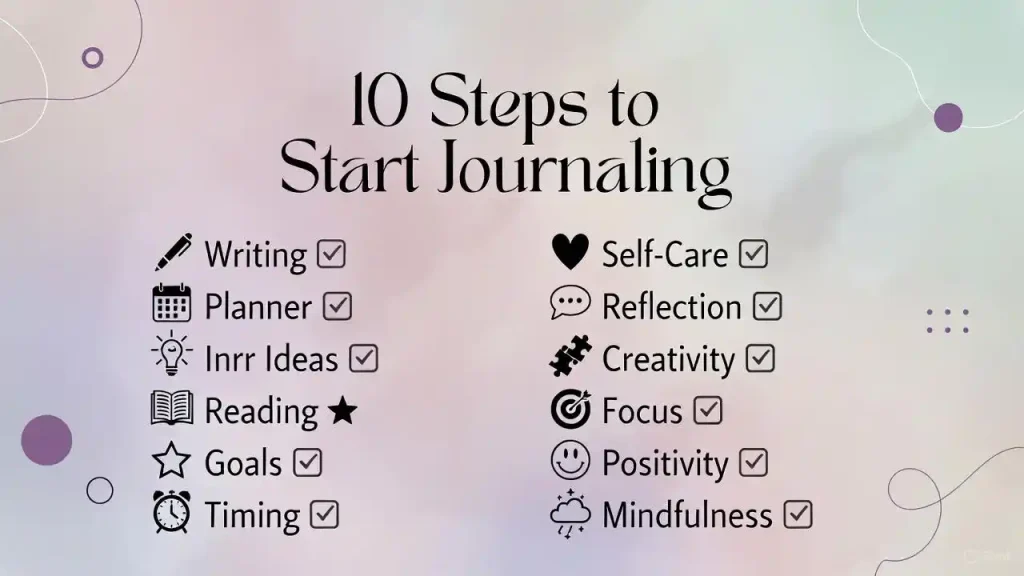
Interactive Checklist
✅ Choose your journal
✅ Set your intention
✅ Pick a routine
✅ Use prompts
✅ Focus on feelings
✅ Experiment with styles
✅ Write for stress relief
✅ Track growth
✅ Overcome blocks
✅ Commit long-term
Key Takeaways
- Journaling is simple but powerful.
- Start small, stay consistent.
- Focus on feelings, not perfection.
- Use prompts to guide your writing.
Pro Tips
- Keep your journal visible (bedside or desk).
- Pair journaling with tea or music for ritual.
- Use a password-protected app if privacy worries you.
FAQ
Q1: How often should beginners journal?
Daily is ideal, but even 3 times a week builds consistency.
Q2: What if I don’t know what to write?
Use prompts like gratitude or emotions. Start with one sentence.
Q3: Can journaling improve mental health?
Yes, it reduces stress and helps process emotions ([Link to Authority Site like Psychology Today/Healthline]).
Q4: Should I keep my journal private?
Absolutely. Privacy ensures honesty and freedom.
Q5: How long should I write each session?
5–15 minutes is enough for beginners.
Conclusion
Journaling is a doorway to clarity, healing, and growth. Starting is the hardest part, but once you begin, the blank page becomes your best friend.
So, what is your experience with journaling? Let me know in the comments—I’d love to hear your story.