
The Problem: You’re Managing, But Are You Truly Leading?
I remember being a first-time manager. I was so excited, but also utterly lost.
If you’re struggling to motivate your team, feel overwhelmed by conflict, or wonder why your best people keep leaving, I want you to know: you are not alone. This is a common, painful reality in the corporate world.
The truth is, most companies promote great individual contributors—the doers—and instantly expect them to become great leaders. But the skills that make a top salesperson are miles apart from the skills that build a thriving team. I learned this the hard way.
The Agitation: The Hidden Cost of Bad Leadership
When I was just “managing” and not “leading,” my stress was through the roof.
I was micro-managing. I was frustrated. My team saw me as a boss, not a guide. I was constantly putting out fires instead of building a solid foundation. Worse, my team’s energy was low, and productivity was sinking. That’s the heavy, hidden toll of ineffective leadership: it costs you time, energy, and, eventually, your best talent.
This is a deep personal development issue. It’s not about how smart you are; it’s about how well you understand the human element.
The Solution: Transform Your Career with the Best Books on Leadership
My turnaround began with a single habit: reading.
I stopped treating books as a chore and started treating them as my personal, always-available leadership coaches. These weren’t just business books; they were deep dives into human psychology, organizational culture, and emotional intelligence. They became my Life Record of growth.
In this guide, I’m sharing the 15 best books on leadership that fundamentally changed my approach—and, honestly, changed my life. They will help you stop just managing tasks and start inspiring people.
By the end of this article, you will have a clear, actionable reading list that will transform you from a boss into a leader.
Table of Contents
🧭 The Foundation: Emotional Intelligence and Self-Mastery
Before you can lead others, you must lead yourself. This is the deepest lesson my personal journey taught me. These first few books are critical for understanding the psychology of leadership.
Book 1: Emotional Intelligence by Daniel Goleman
Goleman showed me that an IQ score is barely half the story.
Emotional Intelligence (EQ) is what truly predicts success. It’s about being aware of your own emotions and managing them, as well as recognizing and influencing the emotions of others. As managers, we have to be the emotional thermostat of the room, not the thermometer.
- Key Takeaway: Self-awareness is your superpower. If you can’t name your own feelings, how can you help a stressed-out team member name theirs?
Book 2: Dare to Lead by Brené Brown
Brown’s research taught me that vulnerability is not a weakness; it is the birthplace of trust.
I used to think a manager had to be tough, stoic, and never show fear. That was a lie I told myself. Dare to Lead gave me the courage to show up, own my mistakes, and create a culture where people felt safe to do the same. This is where real connection starts.
Pro Tip: Don’t just read the book; do the “rumbling with vulnerability” exercises she suggests. It will feel uncomfortable, but that’s the sign of growth.
Book 3: Drive by Daniel H. Pink
If you’re still using a “carrot and stick” approach to motivate your team, you’re missing the point.
Pink explains that for creative, complex work, motivation comes down to three things:
- Autonomy: The desire to direct our own lives.
- Mastery: The urge to get better at something that matters.
- Purpose: The yearning to do what we do in service of something larger than ourselves.
I immediately changed how I delegated after reading this. I stopped telling people how to do things and started explaining why.
🛠️ Building High-Performance Teams & Culture
A high-performing team is a reflection of its leader’s values. These books are the blueprint for building an incredible organizational culture.
Book 4: The 7 Habits of Highly Effective People by Stephen Covey
This book is the bedrock of my personal development journey.
It’s not just about business; it’s about life. The transition from dependence to independence (Habits 1-3) and then to interdependence (Habits 4-6) provides a powerful framework for team development.
- My Favorite Habit: Habit 5: Seek First to Understand, Then to Be Understood. This completely changed how I handled conflict. Instead of defending my position, I focused 100% on listening first. It instantly de-escalated almost every difficult conversation.
Book 5: Good to Great by Jim Collins
Collins introduces the idea of “Level 5 Leadership”—a powerful blend of extreme personal humility and intense professional will.
The most successful leaders are often humble, shunning the spotlight, yet fiercely dedicated to the company’s long-term success. The classic idea of “First Who, Then What” also changed my hiring process. Get the right people on the bus (and the wrong people off the bus) before deciding where to drive it.
Book 6: Leaders Eat Last by Simon Sinek
Sinek uses a powerful biological analogy: the “Circle of Safety.”
A true leader’s job is to ensure the people inside their circle are protected from dangers outside the circle. When people feel safe, they trust each other, and they naturally cooperate. I’ve found that when I prioritize my team’s well-being over short-term results, the long-term results are always better.
Book 7: Extreme Ownership by Jocko Willink and Leif Babin
This is one of the best books on leadership for adopting a mindset of total accountability.
The core idea is simple, yet hard: There are no bad teams, only bad leaders.
If my team fails, I, the leader, own the failure 100%. No excuses. This might sound intimidating, but it’s incredibly freeing. It shifts your focus from blaming to solving. When I started taking Extreme Ownership, my team respected me more, and they started taking more ownership of their own areas.
🚀 The Power of Transformational Leadership (A Core H2 with Focus Keyword)
True transformation happens when you move beyond process management and start leading with vision and purpose. These are some of the best books on leadership that will help you think bigger.
Book 8: Start With Why by Simon Sinek
Why do some leaders inspire and others don’t?
It’s about communicating from the inside out—from the Why (Purpose) to the How (Process) to the What (Product). People don’t buy what you do; they buy why you do it. This principle is vital for getting buy-in on any major project. If you can clearly articulate the purpose, your team will figure out the process.
Book 9: Multipliers by Liz Wiseman
Are you a Multiplier or a Diminisher?
- Diminishers drain energy and intelligence from their teams. (Think micro-managers and idea hoarders.)
- Multipliers amplify the intelligence and capability of the people around them. They ask hard questions and create space for others to contribute.
I learned I was unintentionally diminishing my team by being too quick to offer solutions. Now, I practice asking, “What do you think?” and waiting for the answer.
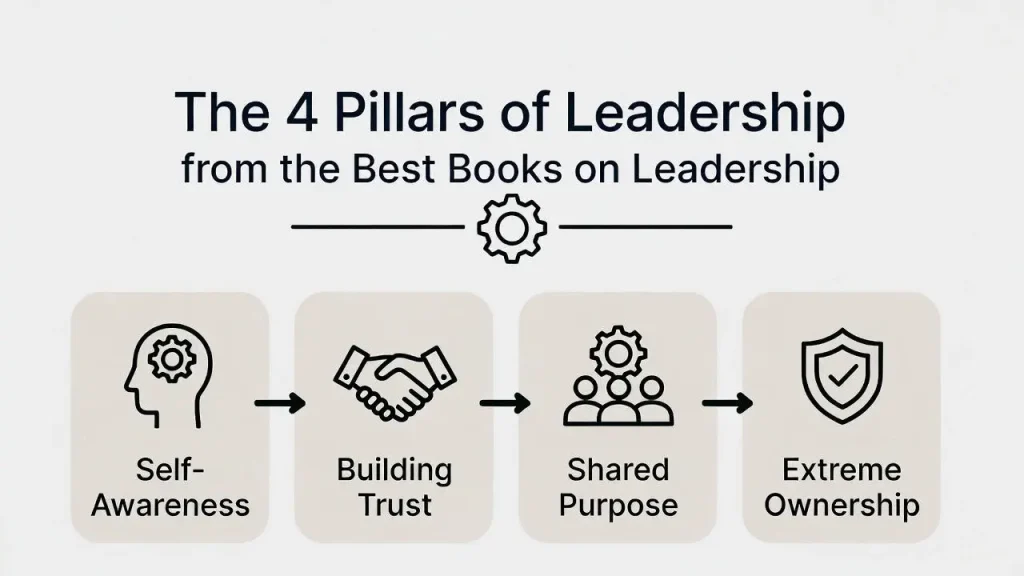
Book 10: The 5 Dysfunctions of a Team by Patrick Lencioni
Lencioni lays out the hierarchy of human connection necessary for team success in a brilliant fable.
At the base is Absence of Trust. Without trust, you can’t have Fear of Conflict. Without healthy conflict, you have Lack of Commitment. Without commitment, you have Avoidance of Accountability. And finally, you get to Inattention to Results. You must build the base first!
- Relevant SoulDairy post – Journaling Benefits That Rewire Your Brain is the most important step in all leadership.
🗣️ Mastering Communication and Influence
Effective leadership is, at its heart, effective communication.
Book 11: Dale Carnegie’s How to Win Friends and Influence People
Yes, this book is nearly 100 years old, but its wisdom is timeless.
It’s the most foundational text on human interaction. If you remember nothing else, remember this: give honest and sincere appreciation, and always try to see things from the other person’s point of view. This is not manipulation; it is profound respect.
Book 12: Crucial Conversations by Kerry Patterson, et al.
This book gave me the tools to handle the hardest parts of the job: performance reviews, budget cuts, and serious conflicts.
A Crucial Conversation is defined by three things: high stakes, differing opinions, and strong emotions. The book teaches you how to maintain “Dialogue”—a free flow of meaning—even when the pressure is on. Staying focused on the mutual goal is the key. Crucial Conversations – The Science of Dialogue
📈 Strategy, Innovation, and Execution
To be a complete leader, you must also guide the organization toward the future.
Book 13: The Innovator’s Dilemma by Clayton Christensen
Christensen introduces the concept of “Disruptive Innovation.”
It explains why great, well-managed companies can still fail. It’s often because they listen too well to their current customers and miss the small, emerging technologies that eventually overthrow the market. This taught me to carve out time, even as a busy manager, to explore seemingly small, unprofitable ideas.
Book 14: Radical Candor by Kim Scott
This book provides a simple, but powerful framework for feedback.
You must focus on two axes: “Care Personally” and “Challenge Directly.”
- Ruinous Empathy (Too nice, doesn’t challenge) is the most common managerial failure.
- Radical Candor is caring enough about someone’s long-term success to give them difficult feedback right now. I learned to deliver difficult news immediately and with compassion.
Book 15: The Effective Executive by Peter F. Drucker
Drucker is the father of modern management.
This book is about getting the right things done. It focuses on the practice of effective execution: time management, focus, maximizing strengths, and making effective decisions. It was a crucial lesson for me: effectiveness is not about being busy; it’s about having impact.
- Relevant SoulDairy post – How to Plan a Successful Week and focus on the vital few tasks.
Key Takeaways: Your Leadership Transformation
| Principle | Action Step |
| Humility | Lead with questions, not answers. Be curious. |
| Trust | Be vulnerable first. Admit your mistakes openly. |
| Motivation | Give your team Autonomy, Mastery, and Purpose. |
| Accountability | Take Extreme Ownership for all team failures. The buck stops with you. |
| Empathy | Seek first to understand (listen for the feelings and the facts). |

📝 Interactive Element: The Leadership Self-Reflection Checklist
The first step in applying these best books on leadership is honest self-assessment. Take 60 seconds and answer this:
- Do I know the personal purpose (the Why) of everyone on my team? (Yes/No)
- Did I give someone constructive criticism and sincere praise this week? (Yes/No)
- When a problem came up, did I immediately ask the team for their solution? (Yes/No)
- When was the last time I admitted to a mistake in front of my team? (This week/This month/Never)
This is your Life Record moment. Be honest. Where you answered ‘No’ or ‘Never’ is your next area for growth.
❓ FAQ: Top Leadership Book Questions
Q: What is the single best book on leadership for new managers?
A: I’d recommend The 7 Habits of Highly Effective People by Stephen Covey. It’s a foundational text that builds personal effectiveness before moving into team leadership, which is the perfect starting point.
Q: Are all these books focused only on business?
A: Absolutely not. The best books on leadership are fundamentally focused on human psychology and personal development. Books like Emotional Intelligence and Dare to Lead offer life lessons that apply to family, friendships, and your career.
Q: What should I read if my team has high conflict?
A: Start with The 5 Dysfunctions of a Team by Patrick Lencioni to understand the root cause (likely a lack of trust). Then, read Crucial Conversations to gain the tools needed to facilitate respectful, high-stakes dialogue.
Q: How can I remember and apply what I read?
A: Don’t just read; interact with the book. Highlight, take notes, and immediately try one concept the next day. I highly recommend keeping a “Leadership Action Log” in your SoulDiary notes app to record specific experiments.
Q: Which book focuses most on organizational culture?
A: Leaders Eat Last by Simon Sinek is phenomenal for understanding organizational culture. It details how psychological safety, built by the leader, becomes the foundation of a resilient, high-trust, and successful workplace culture.
⭐️ Final Thoughts: Your Next Chapter as a Leader
Reading these best books on leadership isn’t about collecting information; it’s about enacting a personal transformation.
For me, the journey from manager to leader felt like a shift from black-and-white to color. It stopped being about controlling outcomes and started being about releasing potential. It’s a messy, beautiful process that will enrich your career and your life.
Your role as a leader is vital. You are the one shaping the environment, fostering the growth, and setting the tone. So, pick one of these books, open it up, and commit to the work.
What is the single most challenging leadership lesson you’ve learned that a book helped you overcome? Let me know your experience in the comments below!
Thank you for your sharing. I am worried that I lack creative ideas. It is your article that makes me full of hope. Thank you. But, I have a question, can you help me?