
I remember the exact moment I realized I had a problem. It was a Tuesday night, 11:30 PM. I was physically exhausted, yet there I was, bathed in the blue light of my phone, doomscrolling through the lives of strangers.
My eyes burned. My mind felt like a browser with 50 tabs open. I wasn’t even enjoying it; I was just… scrolling.
Does this sound familiar?
If you feel constantly drained, anxious, or unable to focus for more than five minutes, you aren’t alone. In our “always-on” culture, our brains are constantly bombarded with information. But here is the good news: you don’t need to throw your smartphone into the ocean to find peace.
In this Life Record guide, I’m sharing 7 realistic digital detox tips that actually work. These aren’t about becoming a monk; they are about reclaiming your mental clarity and becoming the master of your technology, rather than its servant.
Table of Contents
Why You Need a Digital Reset (The Science)
Before we dive into the how, let’s briefly touch on the why. When every “ding” and “buzz” demands your attention, your brain remains in a state of low-level fight-or-flight.
Every notification triggers a small hit of dopamine—the pleasure chemical. Over time, your brain builds a tolerance, requiring more screen time to feel “normal.” This loop destroys mental clarity and increases cortisol (stress).
SoulDairy Insight: A digital detox isn’t about punishment. It’s about giving your nervous system the break it desperately needs to reset.
Tip 1: The “First 30, Last 30” Rule
This is the single most effective change I made in my personal life. Most of us reach for our phones within seconds of waking up. This immediately floods your brain with other people’s demands, news, and stressors before you’ve even brushed your teeth.
The Strategy: Keep your phone away from your bed. Do not look at screens for the first 30 minutes after waking up and the last 30 minutes before sleep.
Why it works:
- Morning: You start the day proactive, not reactive.
- Night: You allow your brain to produce melatonin naturally for better sleep.
Pro Tip: Buy an old-school alarm clock. It removes the excuse of “needing the phone for the alarm.”
Tip 2: Create Sacred Tech-Free Zones
If your phone is everywhere, your mind is nowhere. One of the best digital detox tips is to establish physical boundaries in your home.
Designate specific areas where technology is strictly forbidden.
Recommended Zones:
- The Dining Table: Eat mindfully. Taste your food. Talk to your family.
- The Bathroom: (Yes, really). Let your mind wander rather than scroll.
- The Bedroom: Keep this space for rest and intimacy only.
When I first implemented this, I felt phantom vibrations in my pocket during dinner. That discomfort is proof that the detox is working.
Tip 3: The “Grayscale” Hack
This is a psychology trick that works wonders. Tech companies employ teams of engineers to make app icons colorful and stimulating to keep you hooked.
The Strategy: Go into your phone’s accessibility settings and turn your screen to Grayscale (Black and White).
The Result: Suddenly, Instagram isn’t a vibrant world of envy; it’s just a dull collection of grey squares. The red notification badges don’t trigger the same urgency. You’ll find yourself putting the phone down simply because it’s boring.
Key Takeaway: By removing the color, you remove the emotional trigger that keeps your brain engaged.
Read Souldairy Post : The Psychology of Color: 7 Ways Your Home Affects Your Mood
Tip 4: Curate Your Digital Environment
Just as you declutter your home for peace of mind, you must declutter your digital space. A messy digital feed leads to a messy mind.
Action Steps:
- Unfollow Mercilessly: If an account makes you feel inadequate, angry, or anxious, unfollow it.
- Unsubscribe: spend 10 minutes unsubscribing from marketing emails you never open.
- Delete “Time Vampire” Apps: If you spend 2 hours on TikTok but feel worse afterwards, delete the app. You can always reinstall it later if you truly miss it (spoiler: you won’t).
This isn’t just about reducing time; it’s about increasing the quality of the information you consume.
Tip 5: Rediscover Analog Hobbies
One reason we cling to our phones is that we have forgotten what to do with our hands. When boredom strikes, the phone is the default pacifier.
To succeed with these digital detox tips, you need to replace the digital habit with an analog one.
Ideas to try:
- Reading: Pick up a physical book (not a Kindle). The tactile sensation is grounding.
- Journaling: Write your thoughts by hand. It activates a different part of the brain than typing.
- Walking: Go for a walk without headphones. Listen to the birds and the traffic.
Read : Psychology Today – The Benefits of Hobbies for Mental Health
Tip 6: Turn Off Non-Human Notifications
Do you really need to know that “Uber Eats has a 20% discount” right now? Or that a stranger “liked” your comment from 2018?
Most notifications are noise. They are designed to interrupt you.
The Fix: Go to your settings and turn off all notifications except for:
- Phone calls.
- Text messages from actual humans (friends/family).
- Calendar reminders for meetings.
Turn off badges, banners, and sounds for social media, news, and games. Check these apps on your schedule, not theirs.
Tip 7: Schedule “Do Not Disturb” Blocks
You don’t need to be available 24/7. In fact, being constantly available makes you less productive and less present.
Use the “Do Not Disturb” (DND) feature ruthlessly.
- Deep Work DND: Set a timer for 90 minutes while working. No interruptions allowed.
- Family Time DND: From 6:00 PM to 8:00 PM, the phone goes away so you can be present with loved ones.
My Experience: I was terrified that I would miss an “emergency.” In ten years of doing this, I have missed exactly zero genuine emergencies. If it’s urgent, they will call twice (most phones have a “bypass DND for repeated calls” setting).
Read : Personal Growth Archieve
Interactive: Are You Addicted? (Checklist)
Take a moment to reflect. How many of these apply to you?
- [ ] Do you panic when you can’t find your phone?
- [ ] Do you check your phone immediately upon waking up?
- [ ] Do you take your phone into the bathroom?
- [ ] Do you feel your phone vibrate when it hasn’t?
- [ ] Do you lose track of time while scrolling (looking up to realize an hour has passed)?
Results: If you checked 3 or more boxes, your brain is craving a reset. Pick two tips from the list above and start today.
Frequently Asked Questions
Q: How long should a digital detox last?
A: It depends on your goal. A “mini-detox” can be 24 hours (like a Sunday). However, to reset your habits, try implementing these boundaries for 30 days. It takes time to break the dopamine cycle.
Q: Will I lose touch with my friends?
A: No. In fact, your connections usually deepen. You stop trading “likes” and start having real conversations. Tell your close friends you are taking a break; they will often support you (and might even join in).
Q: What if I need my phone for work?
A: Be specific about boundaries. Use the phone only for work tasks during work hours. Remove social media apps from your work device to prevent “accidental” scrolling during downtime.
Q: Can I listen to music during a detox?
A: Yes! Music is therapeutic. However, try to use a device that doesn’t have a screen (like a smart speaker) or download a playlist and put the phone in airplane mode so you aren’t tempted to check emails between songs.
Q: What is the hardest part of a digital detox?
A: The boredom. We have conditioned ourselves to never be bored. When the boredom hits, don’t run from it. Sit with it. That boredom is the birthplace of creativity and mental clarity.
Conclusion
Implementing these digital detox tips isn’t about hating technology. Technology is a tool. But a hammer is useful when building a house; it’s not useful if you are hitting yourself in the head with it every five minutes.
By setting boundaries, turning off notifications, and reclaiming your morning routine, you are telling your brain that you are in charge.
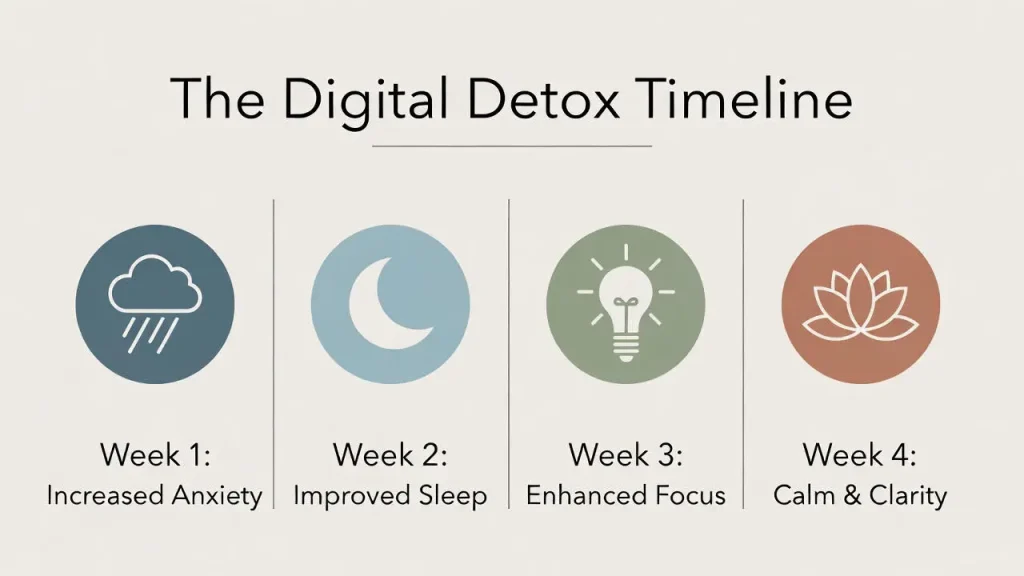
The result? The mental fog lifts. Your anxiety drops. And suddenly, you have time for the things that actually matter—connection, creativity, and peace.
I’d love to hear from you: Which of these tips feels the most “doable” for you right now? Have you ever tried a social media break? Let me know your experience in the comments below!