
Have you ever woken up, looked at the calendar, and wondered where the last few years went?
I’ve been there. I remember sitting on my secondhand sofa five years ago, feeling a heavy knot in my chest. I wasn’t “failing” on paper, but I was definitely drifting. I was reacting to life rather than creating it. That specific feeling of stagnation is what we call “passive living” in psychology, and it is the silent killer of potential.
The truth is, most people spend more time planning their annual vacation than they do planning their life.
If you are reading this, you are ready to stop drifting. You are ready to take the wheel. Creating a 5 year personal development plan isn’t about rigidly scripting every second of your future—it’s about building a compass so that no matter where the wind blows, you are always moving toward your “North Star.”
In this “Life Record” guide, I’m going to walk you through the exact framework I used to pivot my career, improve my mental health, and find genuine fulfillment.
Let’s get to work.
Table of Contents
Why You Need a 5 Year Personal Development Plan
You might be thinking, “Five years? I don’t even know what I’m having for dinner tonight!”
That’s a fair point. But here is the psychology behind it: The brain craves direction. When you don’t give your Reticular Activating System (RAS) a target, it filters out opportunities. When you do have a plan, you suddenly start seeing doors opening that you previously walked right past.
A 5 year personal development plan bridges the gap between your current reality and your potential. It acts as a contract with yourself. It moves you from “I wish” to “I will.”
SoulDairy Note: A plan is not a prison. It is a living, breathing document. It allows you to say “no” to things that don’t align with your values and “yes” to things that do.
Step 1: The Brutally Honest Self-Assessment
Before you can set a destination for your GPS, you have to know your current location. This step requires vulnerability. You need to look at your life without filters.
I recommend using a variation of the SWOT Analysis, but applied to your personal life:
- Strengths: What comes naturally to you? (e.g., empathy, coding, public speaking).
- Weaknesses: What holds you back? (e.g., procrastination, fear of conflict, lack of technical skills).
- Opportunities: What trends or situations can you leverage?
- Threats: What obstacles stand in your way? (e.g., financial debt, toxic relationships).
When I did this, I realized my biggest weakness was a lack of discipline in my morning routine. That one realization changed everything.
Read Souldairy Personal Growth Catagory
Step 2: Defining Your “North Star” Vision
Now that we know where we are, let’s dream a little.
Close your eyes. Imagine it is exactly five years from today. You wake up.
- Where are you living?
- Who is lying next to you?
- How does your body feel?
- What work are you excited to do today?
- What is your bank balance?
Write this down in present tense. This is your Vision Statement.
Example: “It is 2030. I am living in a quiet cottage near the coast. I run a consultancy business that helps non-profits. I am debt-free, I run 5k three times a week, and I speak fluent Spanish.”
This narrative serves as the emotional anchor for your 5 year personal development plan.
Step 3: The SMART Goal Framework
A vision without a deadline is just a hallucination. We need to turn that vision into data. You’ve likely heard of SMART goals, but we are going to apply them strictly to your 5-year timeline.
S.M.A.R.T. stands for:
- Specific
- Measurable
- Achievable
- Relevant
- Time-bound
Don’t say: “I want to get healthy.” Do say: “By December 2028, I will run a half-marathon in under 2 hours and maintain a body fat percentage of 18%.”
Authority Site: Psychology Today – The Science of Goal Setting
Step 4: Breaking the Big Picture Down
This is where most people fail. They stare at the massive 5-year goal and freeze. The mountain looks too high.
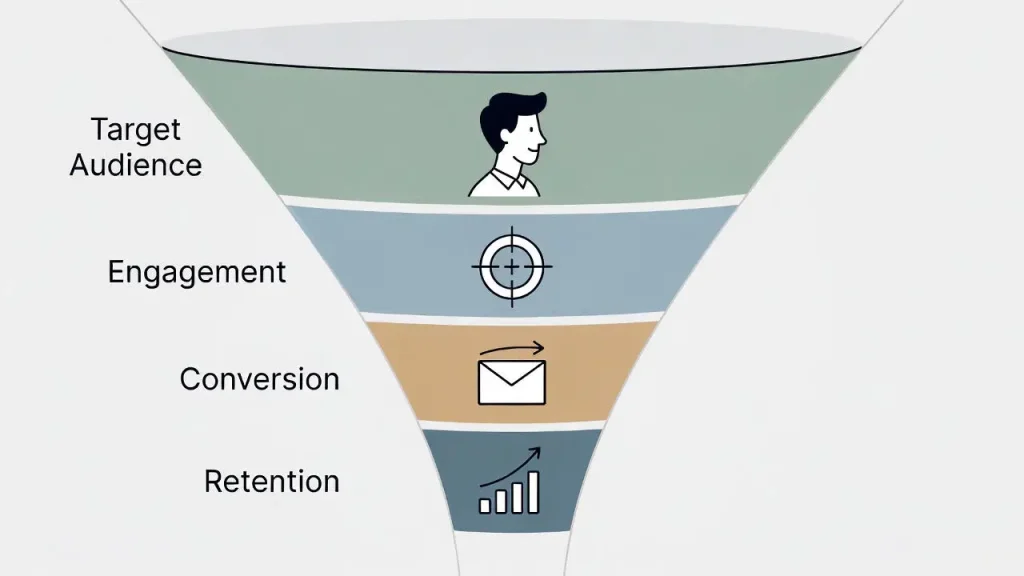
You need to reverse engineer your success using the Funnel Method:
- 5-Year Goal: Launch a successful digital marketing agency.
- 1-Year Goal: Secure first 5 paying clients and build a portfolio.
- Monthly Goal: Network with 10 business owners and post daily content on LinkedIn.
- Weekly Goal: Send 20 cold emails.
- Daily Habit: Write for 30 minutes before breakfast.
Do you see how manageable that daily habit is? That small habit is the brick that builds the house of your 5 year personal development plan.
Step 5: Identifying the Skills Gap
To achieve things you have never achieved, you must become someone you have never been. This usually requires new skills.
Look at your goals from Step 3. What skills are missing?
- Hard Skills: Data analysis, foreign languages, coding, video editing.
- Soft Skills: Negotiation, emotional intelligence, public speaking, leadership.
Pro Tip: Choose one major skill to master 5 year personal development plan. Don’t try to learn Python, Spanish, and Piano all at the same time. You will burn out.
Step 6: Anticipating the “Dip”
In every journey, there is a moment Seth Godin calls “The Dip.” It’s that moment 3 weeks or 3 months in when the excitement fades, the results haven’t shown up yet, and the work gets hard.
Create an “If/Then” Strategy:
- If I feel too tired to go to the gym, Then I will just put on my shoes and walk for 5 minutes.
- If I get rejected from a job interview, Then I will apply to three more the next day.
By deciding how you will react before the problem happens, you remove emotion from the decision-making process.
Step 7: The Review and Pivot
A 5 year personal development plan set in stone is a recipe for disaster. You will change. The world will change.
Schedule a “CEO Date” with yourself:
- Weekly: Review your habits.
- Quarterly: Review your projects.
- Yearly: Review your Vision.
If you find that a goal no longer serves you (e.g., you wanted to be a lawyer, but now you love graphic design), change the plan. That isn’t quitting; that’s pivoting.
Read Also : 7 Ways Your Home Affects Your Mood
🧩 Interactive: The 5-Minute Clarity Audit
Grab a pen. Rate your satisfaction in these areas from 1-10 right now:
- Health & Vitality: ___/10
- Career & Finances: ___/10
- Relationships & Love: ___/10
- Spiritual & Emotional: ___/10
Your Assignment: Pick the lowest number. That is the priority area for Year 1 of your 5 year personal development plan.
❓ Frequently Asked Questions
Is 5 years too long to plan for?
Not at all. While you can’t predict the future, a 5-year horizon encourages “long-term thinking” over instant gratification. It’s about setting a direction, not predicting the lottery numbers.
What if I fail to reach my goals?
Failure is data. If you aim for 100% and hit 80%, you are still significantly further ahead than if you had aimed for nothing. Adjust your timeline and keep moving.
Should I use an app or a physical journal?
For “Life Record” purposes, I always recommend a physical journal for the initial brainstorming—handwriting connects to the brain differently. However, use digital tools (like Trello or Google Calendar) for tracking daily tasks.
Can I have goals for different areas of life?
Absolutely. A holistic plan must cover health, wealth, and relationships. If you double your income but destroy your marriage, that is not success in 5 year personal development plan
How do I stay motivated after the first month?
Motivation is unreliable; habits are dependable. Focus on building the “systems” (Step 4) rather than relying on hype. Discipline creates freedom.

Conclusion
Creating a 5 year personal development plan is an act of self-love. It is you telling the universe—and yourself—that your life matters and is worth designing.
Remember, the time is going to pass anyway. Five years from now, you will arrive somewhere. The question is: will you arrive at a destination you chose, or somewhere you just ended up?
Start today. Even if it’s just writing down one sentence about your future in 5 year personal development plan
What is the ONE major goal you want to achieve in the next 5 years? Drop it in the comments below—I read every single one!
Reading your article helped me a lot and I agree with you. But I still have some doubts, can you clarify for me? I’ll keep an eye out for your answers.