
1. Introduction: Escaping the Clutter Trap
Minimalist office setup—the phrase sounds almost like a fantasy, doesn’t it?
- Problem: If your desk is buried under a mountain of papers, and your computer desktop looks like a digital graveyard, you’re not alone. I know that feeling of mild, constant overwhelm. That subtle hum of anxiety that kicks in every time you sit down to work.
- Agitation: It’s not just about looks. That visual noise—the physical and digital clutter—is actually costing you. It’s draining your cognitive load, making it harder to focus, and slowing down your decision-making. We pay a hidden tax on every unnecessary item we own.
- Solution: But what if I told you that by embracing the simple principles of minimalism, you could reclaim not just your desk, but your mental clarity, too?
I’ve been on this journey myself. I realized my cluttered desk was a mirror of my scattered mind. Since adopting a minimalist office setup, I’ve felt a powerful shift.
The Promise: By the end of this deep dive, you’ll have a clear, actionable plan to declutter your entire workspace—physical and digital—leading to a state of peak focus and genuine peace.
Table of Contents
2. Why Less is More: The Psychology of Clutter
A truly effective minimalist office setup is a psychological strategy, not just a cleaning exercise.
My personal journey into minimalism began when I realized I was spending 15 minutes every morning just looking for the one pen I liked. That’s 15 minutes of energy wasted before my workday even started!
Research from Princeton University’s Neuroscience Institute found that an excess of visual stimuli—clutter—competes for your attention. Psychology Today
This competition reduces your focus and increases your stress.
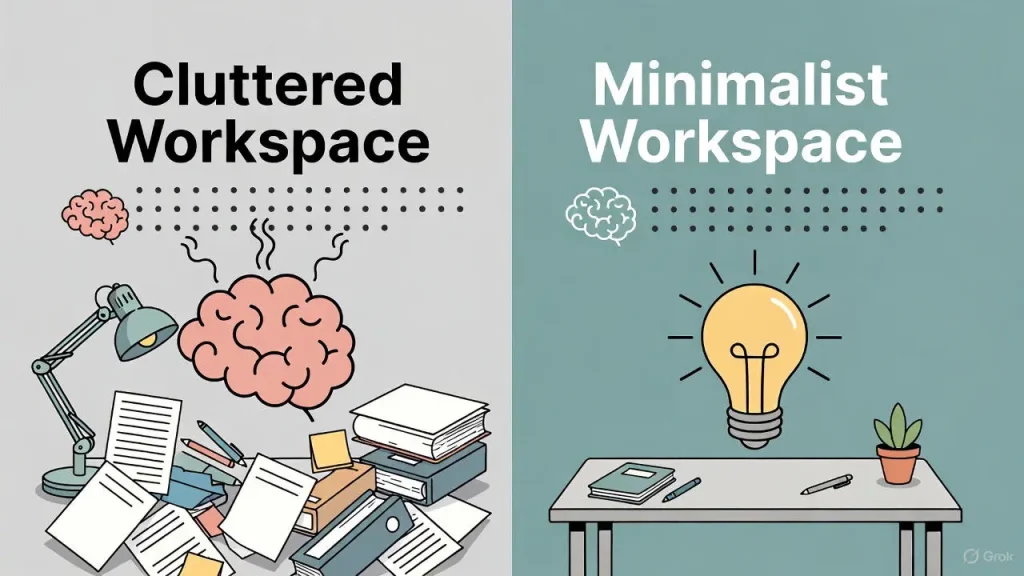
The Hidden Benefits of Minimalism:
- Reduced Cognitive Load: Fewer items mean fewer decisions. Your brain is freed up for important tasks.
- Increased Productivity: You spend less time searching and more time doing.
- A Clearer “Life Record”: A clean space makes it easier to track your goals and see your progress without distraction.
- Enhanced Sense of Control: Taking control of your space is a powerful first step in taking control of your life.
3. Phase 1: The Physical Office Declutter
This is often the most satisfying part. We’re going to treat your desk like a high-value piece of real estate. Only the essentials are allowed.
3.1. The “One-In, One-Out” Desk Rule
Start with a brutal purge. Empty your entire desk. Seriously, everything.
Now, use the “KonMari Method” principle: only put back what “sparks joy” and is essential for your current tasks.
- The 80/20 Rule: You likely only use 20% of the items on your desk 80% of the time. Get rid of the other 80%.
- Designated Homes: Every item that stays must have a clear, designated home. If it doesn’t, it becomes clutter.
- Paperless Mindset: Can this document be scanned? If so, toss the original (after scanning, of course!).
I used to keep three staplers, ‘just in case.’ Now, I have one. The fear of ‘what if I need it?’ is always less damaging than the reality of constant clutter.
3.2. Choosing Essential Tools Only
This is where the term “minimalist desk” really comes into play. Think quality over quantity.
Focus on the following items for a true minimalist office setup:
- The Computer: Your core tool.
- One Monitor: (Unless your work absolutely requires two—be honest!)
- One Writing Instrument: (Your favorite pen—the one that always works).
- One Notebook/Planner: For deep work notes, not to-do scraps.
- A Single Lamp: For focused, warm light.
If you don’t use it daily, store it in a drawer or a cabinet out of sight. Remember the goal: visual calm.
3.3. Taming the Cable Monster
Nothing ruins a clean aesthetic faster than a tangle of cables. This is a subtle, but important form of clutter.
- Use cable ties or velcro straps.
- Invest in a cable management box or tray under your desk.
- Where possible, switch to wireless peripherals (mouse, keyboard).
The space under your desk should be as tidy as the surface. It improves the energy of your workspace, even if you can’t see it constantly.
Read More : The Psychology of Color: 7 Ways Your Home Affects Your Mood
4. Phase 2: Mastering the Digital Declutter (The Unseen Workspace)
A physical minimalist office setup is only half the battle. Your digital world is often the worst offender for generating mental noise.
4.1. The Desktop Zero Challenge
Take a moment to look at your computer desktop. Is it covered in random files, screenshots, and folders?
Digital Clutter = Digital Anxiety.
The challenge: Desktop Zero.
- Move Everything: Create a temporary folder called “Archive_TEMP_2025” and move everything from your desktop into it.
- The Rule: Your desktop’s sole purpose is to hold files you are actively working on right now.
- Maintain: Once the task is finished, the file is immediately saved to its permanent home in your filing system (see 4.3) or deleted. Never let it linger.
This is the single most effective step I took to reduce my day-to-day work stress.
4.2. Streamlining Your Inbox and Notifications
An overflowing inbox is a digital barrier to entry for focused work. It’s a constant, low-level interruption.
- Unsubscribe: Dedicate 30 minutes to ruthlessly unsubscribe from every mailing list you don’t actively read.
- The Two-Minute Rule: If an email can be dealt with in under two minutes, do it immediately (Reply, Delete, or Delegate).
- Batch Notifications: Turn off all non-essential notifications (Slack, news alerts, social media). Check these only at set times (e.g., 10 am, 2 pm, 4 pm). You choose when to engage; don’t let the apps choose for you.
4.3. Creating an Intentional Filing System
In a minimalist office setup, your files should be easily searchable, not just “hidden.”
Your filing system—whether cloud-based or local—should be logical and consistent.
- The Folder Hierarchy: Don’t go more than three layers deep (e.g.,
1. Clients>Project X>Invoices). - Consistent Naming: Use a simple, repeatable structure (e.g.,
YYYY-MM-DD_ProjectName_DocumentType). This makes searching instantaneous. - Regular Purge: Schedule 15 minutes at the end of every week to clean up your “Downloads” folder and your “Archive” folder.
This structure allows you to find any digital file in seconds, eliminating the friction and frustration that leads to procrastination.
Read More : 55+ Positive Affirmations for Confidence and Success That Actually Work
5. Reflection & Action: Your Minimalist Office Setup Checklist
To help you get started, here is a quick, actionable checklist. Use this to guide your first week.
📝 Minimalist Office Setup Quick-Start Checklist
- Day 1: The Physical Purge
- Clear every item off the desk surface.
- Only put back 5-7 essential items.
- Install a cable management solution.
- Day 2: The Digital Purge
- Implement the “Desktop Zero” challenge.
- Create a simple, three-layer file structure.
- Day 3: The Inbox Attack
- Unsubscribe from 10+ unnecessary mailing lists.
- Turn off all desktop notifications for non-essential apps.
- Day 4 & Beyond: Maintenance
- Practice the “One-In, One-Out” desk rule daily.
- Schedule a 15-minute weekly digital clean-up.
6. Key Takeaways
- Your minimalist office setup is a tool for mental clarity, not just a style choice.
- Clutter, both physical and digital, increases your cognitive load and reduces focus.
- The principles of essentialism (keeping only what is necessary) apply to both your desk and your digital folders.
- A clean workspace is the foundation for a more intentional “Life Record” and higher office productivity.
- Start small: The “Desktop Zero” challenge offers the fastest and most satisfying results.
7. Pro Tips for Sustaining Your Minimalist Office Setup
Pro Tips from a SoulDairy Editor
- The 5-Minute Reset: Dedicate the last 5 minutes of your workday to putting everything in its place. When you return tomorrow, your desk will be waiting for you, ready for deep work.
- The Single Decorative Item: Allow yourself one item that is purely for inspiration or beauty (a favorite photo, a plant, etc.). This prevents the space from feeling sterile.
- The Vertical Rule: When organizing storage, go vertical! Shelves and stacked trays are more space-efficient than spreading things horizontally.
- Use the Cloud for Storage: If you don’t need a file immediately, archive it to the cloud. Only keep essential, current project files on your local drive.
8. Frequently Asked Questions (FAQ)
Q: What is the ideal number of items on a minimalist desk?
A: The ideal number is subjective, but a good target is 5 to 7 items: your computer, input devices, one notebook, one pen, and perhaps a lamp. If you don’t use it hourly, put it away.
Q: Does minimalism apply to my computer wallpaper?
A: Absolutely. A simple, solid-color or abstract desktop background reduces visual competition for your attention, contributing directly to a more focused minimalist office setup.
Q: How can I deal with documents I need to keep for tax purposes?
A: Dedicate a single, clearly labeled filing cabinet or drawer away from your main desk. Digitize all non-essential records, and only store the legal originals in this designated “archive.”
Q: Will a minimalist workspace make me feel less creative?
A: The opposite is often true. By removing distractions, minimalism frees up mental bandwidth, allowing your creativity to flow without the “noise” of clutter. A clear space fosters a clear mind.
Q: I work from home. How do I maintain work-life balance with a minimalist setup?
A: Physically put away your work tools at the end of the day. Close the office door, cover your monitor, or put your laptop in a drawer. This signals to your brain that the workday is officially over, protecting your personal life record.

9. Conclusion: The Power of the Empty Space
I used to believe that a cluttered desk meant I was busy, important, and working hard. Now, I understand that it only meant I was overwhelmed, distracted, and working inefficiently.
Creating a minimalist office setup is an act of self-care. It’s a statement that your focus, your energy, and your mental peace are more valuable than any piece of paper or unnecessary gadget.
The empty space on your desk is not a void; it’s an invitation. An invitation for focus, for clarity, and for high-value, deep work.
What is the one thing—physical or digital—you’re going to remove from your workspace today? Let me know in the comments!