
Have you ever reacted to a situation with a level of anger that surprised even you? Or perhaps you find yourself constantly judging others for being “lazy” or “selfish,” only to realize deep down, you envy their freedom?
I know exactly how that feels.
For years, I kept a pristine “Life Record.” I was the “good person”—always helpful, always calm, always perfect. But behind that mask, I was exhausted. I was carrying a heavy invisible backpack filled with resentment, jealousy, and fear. I didn’t know it then, but I was running from my Shadow.
If you feel like you are fighting a war against parts of yourself, you are in the right place.
In this guide on shadow work for beginners, we aren’t going to banish your demons. We are going to invite them in for tea. By the end of this post, you will understand exactly what the shadow is, why it exists, and how to integrate it to unlock a life of authentic wholeness.
Table of Contents
What Exactly is the “Shadow”?
Before we dive into the exercises, we need to define what we are working with. The concept was popularized by the famous Swiss psychiatrist Carl Jung.
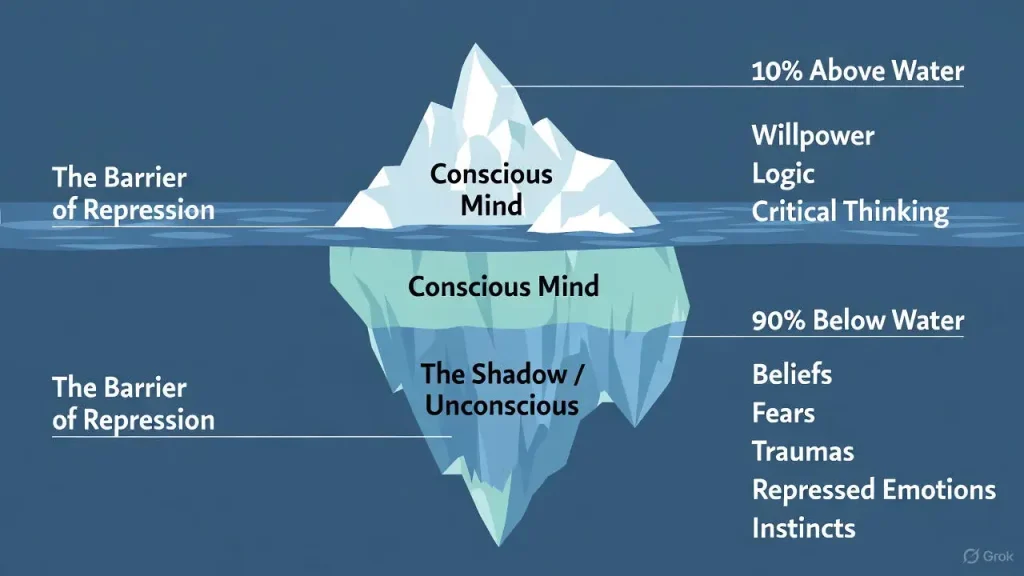
In simple terms, your “Shadow” is the unconscious part of your personality. It contains everything your conscious mind has rejected, denied, or hidden away because it didn’t fit the image of who you wanted to be.
“Until you make the unconscious conscious, it will direct your life and you will call it fate.” — Carl Jung
It’s Not Just “Evil” Traits
When we hear “dark side” or “shadow,” we often think of violence or hatred. But your shadow also contains Golden Shadows—positive traits you repressed because you were told they were “too much.”
- Examples of Shadow Traits: Rage, envy, greed.
- Examples of Golden Shadow Traits: Creativity, personal power, sexuality, spontaneity.
Think of your mind like an iceberg. The tip is what you show the world. The massive structure underwater? That is where the shadow work for beginners really begins.
Why Do We Have a Dark Side?
Nobody is born with a shadow. We are born whole. So, where does it come from?
It starts in childhood. As we grow up, we learn that certain behaviors get us love (acceptance) and others get us punished (rejection).
Consider this “Life Record” scenario: Imagine a little boy named Sam. When Sam cries, his father says, “Stop crying! Big boys don’t cry.” Sam wants his father’s love. So, he takes his sadness and vulnerability, shoves them into a bag, and throws them into the basement of his mind. Sadness becomes his shadow.
Thirty years later, Sam is a man who cannot connect emotionally with his wife because he has “shadowed” his ability to be vulnerable.
This process of splitting ourselves happens to everyone. It is a survival mechanism. But what saved us as children often destroys us as adults.
Signs You Need to Do Shadow Work
How do you know if your shadow is running the show? Here are the most common red flags I see in my work at SoulDairy:
- Projection: You have an intense, irrational dislike for someone you hardly know. (Usually, they possess a trait you are suppressing in yourself).
- Disproportionate Reactions: You spill coffee and fly into a rage that lasts for hours.
- ** repetitive Patterns:** You keep dating the same toxic type of person or losing jobs for the same reason.
- Feeling “Fake”: You feel like you are constantly performing a role rather than being yourself.
Pro Tip: The things that annoy you most in others are your best clues. They are mirrors reflecting your own shadow.
[Link to relevant SoulDairy post: “7 Bad Habits Killing Productivity You Must Break“]
The Golden Rule of Safety (Read Before Starting)
This is crucial. Shadow work is powerful, but it can be intense.
If you have a history of severe trauma, PTSD, or a dissociative disorder, please do not attempt deep shadow work alone. Work with a licensed therapist or a trauma-informed coach.
Shadow work for beginners should be done with self-compassion, not self-hatred. If you feel overwhelmed, stop. Ground yourself. Return to it later.

How to Practice Shadow Work: 7 Actionable Steps
Ready to open the basement door? Here is a step-by-step framework to begin your journey.
1. Spot the Trigger
For the next week, act as a detective of your own life. Notice when your mood shifts suddenly.
- Did someone cut you off in traffic?
- Did a friend’s success make you feel small?
- Did a comment on social media make your blood boil?
Don’t fix it. Just notice it.
2. The “3-2-1” Exercise
This is a brilliant technique adapted from Ken Wilber. Pick a person who triggers you.
- 3rd Person (Describe them): “He is arrogant, loud, and doesn’t care about anyone.”
- 2nd Person (Talk to them): “You make me so angry because you take up all the space in the room.”
- 1st Person (Be them): “I am arrogant. I am loud. I take up space because I want to be seen.”
By becoming the trigger, you reclaim the projected energy.
3. Dialogue with the Shadow
Journaling is the bread and butter of shadow work for beginners. Try this: Sit in a quiet space. Close your eyes. Imagine the part of you that you hate (e.g., your jealousy) is sitting in a chair opposite you.
Ask it questions:
- “What do you want to tell me?”
- “What are you trying to protect me from?”
- “What do you need?”
Write down the answers without filtering. You might be surprised to find that your jealousy is just trying to protect your dreams.
4. The “Why” Laddering Technique
When you feel a negative emotion, ask “Why?” five times to get to the root.
- I’m angry. Why? Because he ignored my text.
- Why does that matter? Because it feels disrespectful.
- Why? Because it makes me feel unimportant.
- Why? Because I am terrified of being abandoned.
Bingo. That is the shadow.
5. Meditation and Observation
You don’t always need to analyze. Sometimes, you just need to feel. “Benefits of Mindfulness for Emotional Regulation “
Practice “sitting with the discomfort.” When a shadow emotion rises, locate it in your body (tight chest, hot face). Breathe into it. Say to yourself, “I see you. You are allowed to be here.”
6. Heal the Inner Child
Since the shadow was born in childhood, you must go back there to heal it. Look at a photo of yourself as a child. Tell that child that it is safe to be angry, sad, or wild now. You are the adult, and you can handle it.
7. Integration
This is the final step. Once you identify a shadow trait, find a healthy outlet for it.
- Repressed Aggression? Take up boxing or martial arts.
- Repressed Vanity? Dress up and take photos just for yourself.
- Repressed Sadness? Watch a tear-jerker movie and let yourself ugly cry.
🛑 Interactive Reflection
Take a moment right now. Think of the last person who made you really angry. What is the one adjective you would use to describe them? (e.g., Selfish, Lazy, Arrogant) Reflection: Where does that trait live in you? Do you suppress it, or do you secretly wish you could be a little bit more like that?
Common Pitfalls for Beginners
As you start shadow work for beginners, watch out for these traps:
- The “Shame Spiral”: Using your shadow discoveries to beat yourself up. Remedy: Radical self-forgiveness.
- Shadow “Bypassing”: Intellectualizing your feelings instead of feeling them. Remedy: Focus on body sensations.
- Over-identifying: Thinking you are your shadow. Remedy: Remember, you are the sky; the shadow is just a cloud passing through.
Conclusion: Your New Life Record
Embracing your dark side isn’t about becoming a bad person. It is about becoming a whole person.
When I finally accepted my own anger, I stopped being passive-aggressive. I started setting boundaries. My “Life Record” changed from a story of victimhood to a story of empowerment.
Shadow work for beginners is a journey, not a destination. It requires courage, but the reward is freedom. You stop running from yourself. You stop projecting your pain onto others. You finally come home.
Are you ready to meet yourself?
FAQ
Is shadow work dangerous?
For most people, it is safe but uncomfortable. However, if you have a history of severe trauma or mental health instability, it is best done with a therapist to avoid re-traumatization.
How long does shadow work take?
It is a lifelong process. There is no finish line. As you grow and evolve, new layers of the shadow will reveal themselves. Consistency is more important than speed.
Can I do shadow work without a journal?
Yes, you can use meditation, voice recording, or art therapy. However, writing is highly recommended for shadow work for beginners because it helps structure chaotic thoughts.
What are the benefits of shadow work?
Benefits include improved relationships, higher energy levels (repressing emotions takes energy!), greater creativity, emotional maturity, and a deep sense of inner peace.
5. How do I know if I’m doing it right?
You will feel a sense of relief or release, followed by a shift in your behavior. If you stop reacting to old triggers, you know the work is integrating.
[Link to relevant SoulDairy post: “15 Best Books on Leadership Every Manager Must Read“]