
Maintaining Work life balance in a high pressure career often feels like trying to meditate in the middle of a hurricane. I know the feeling all too well. You close your laptop at 8:00 PM, but your mind is still processing the client’s demands, the upcoming deadline, and that one email you might have misinterpreted.
The anxiety creeps in. Your sleep suffers. Eventually, you find yourself staring at the ceiling at 3:00 AM, wondering if professional success requires personal sacrifice.Many ambitious professionals feel that maintaining Work life balance in a high pressure career is nearly impossible, but with the right mindset, it is achievable.
Here is the truth: It doesn’t have to be this way.
As someone who has navigated the chaotic waters of senior management for over a decade, I can tell you that balance isn’t a destination; it’s a discipline. If you are feeling overwhelmed, you are in the right place. By the end of this SoulDairy Life Record, you will have a toolkit of psychological strategies and practical habits to reclaim your peace without stalling your promotion.
Table of Contents
The Myth of “Having It All”
We have been sold a lie. The corporate world often glamorizes the “hustle culture”—the idea that if you aren’t tired, you aren’t working hard enough.
But in my experience, burnout is not a badge of honor. It is a productivity killer.
Achieving Work life balance in a high pressure career doesn’t mean splitting your hours 50/50 between the office and home. That is mathematically impossible for many of us. Instead, it is about energy management and presence.
SoulDairy Insight: Balance is not about time; it is about where your mind is. If you are at dinner with family but thinking about spreadsheets, you are still at work.
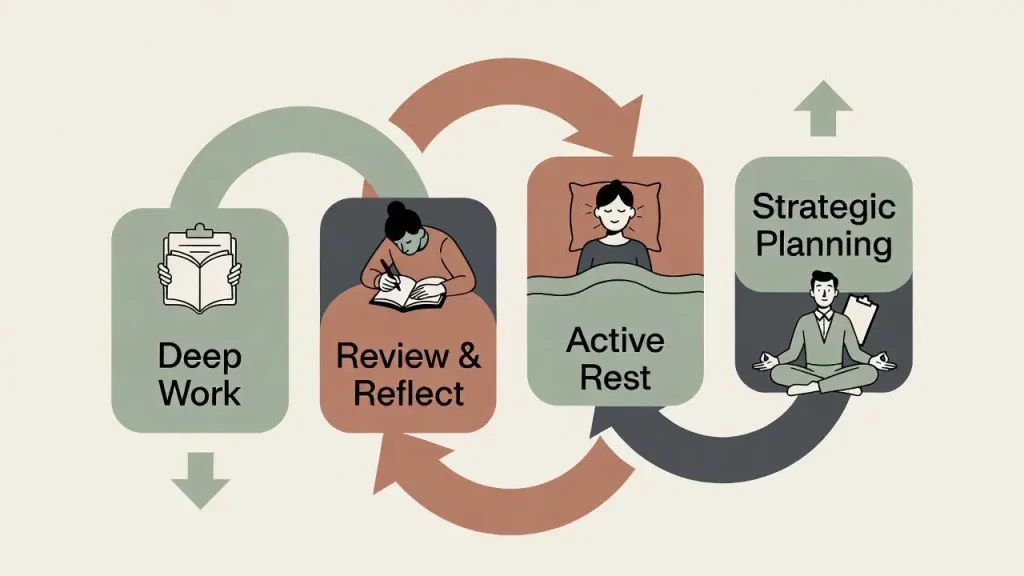
The Psychology of High Achievers
Why do we do this to ourselves? Psychology tells us that high achievers often tie their self-worth to their output. We fear that setting boundaries will make us look weak or uncommitted.
However, [research from the American Psychological Association] shows that chronic stress actually shrinks the prefrontal cortex—the part of the brain responsible for decision-making. By overworking, you are biologically making yourself worse at your job.

10 Strategies for Work life balance in a high pressure career
Through trial, error, and plenty of therapy, I’ve developed these ten non-negotiable rules. These aren’t just fluffy tips; they are survival mechanisms.
1. Master the “Hard Stop” Ritual
In a high-pressure job, the work never “finishes.” You have to decide when it ends. I have a hard stop at 6:30 PM.
- The Ritual: I close my tabs, write my to-do list for tomorrow, and physically shut my laptop.
- The Psychology: This signals to your brain that “work mode” is deactivated.
2. The Power of Micro-Boundaries
You don’t need to vanish for weeks. You need micro-boundaries throughout the day.
- Don’t check email before 9:00 AM.
- Take a 15-minute walk without your phone at lunch.
- Turn off notifications during “Deep Work” blocks.
3. Communicate Expectations Early
Your boss isn’t a mind reader. If you are handling a high-stakes project, communicate your availability.
- Say this: “I am fully focused on Project X. To ensure quality, I will be responding to emails only twice a day.”
4. Optimize Your Output, Don’t Maximize Your Hours
Are you being productive, or just “busy”?
- Use the Eisenhower Matrix to delete, delegate, defer, or do.
- Stop perfecting tasks that only require “good enough” effort.
5. Schedule Your “Joy Blocks”
If you don’t schedule it, it won’t happen. Put your gym session, date night, or reading time in your calendar in red ink. Treat these appointments with the same respect you treat a client meeting.
6. Practice “Digital Minimalism”
The blue light from your phone is the enemy of rest.
- Pro Tip: Buy an old-school alarm clock. Charge your phone in the kitchen, not the bedroom. This one change saved my sleep schedule.
7. Learn the Art of the “Positive No”
Saying no is the ultimate skill for Work life balance in a high pressure career.
- The Template: “Thank you for thinking of me for this. My plate is currently full with [Priority Project], so I can’t give this the attention it deserves right now. Can we revisit this next quarter?”
8. Use Your Vacation Days (All of Them)
Leaving vacation days on the table is essentially paying your company to work for free. Taking breaks resets your cortisol levels, making you sharper when you return.
9. Build a “Third Space”
You need a transition zone between work and home.
- Examples: A podcast during your commute, a 20-minute gym session, or a ritual of changing clothes immediately upon getting home. This “Third Space” allows you to shed the professional armor.
10. Outsource Life Admin
If you have the budget, buy back your time.
- Order groceries online.
- Hire a cleaner once a month.
- Use laundry services. Your time is your most expensive asset. Spend it on recovery, not chores.
You Need Mental Clarity? Read this post : How to Reset Your Life Before
Life Record: My Daily Routine for Sanity
To show you what this looks like in practice, here is a snapshot of my typical Tuesday as a Senior Editor.
- 6:30 AM: Wake up. No phone. Drink water.
- 7:00 AM: 30 minutes of movement (Yoga or Running).
- 8:00 AM: Breakfast with family (Phone still away).
- 9:00 AM: Work Start. Review top 3 priorities.
- 1:00 PM: Lunch break. I leave my desk. Even if it’s just to the kitchen.
- 4:00 PM: “Slump” management. I drink herbal tea and handle low-energy tasks like admin.
- 6:30 PM: Hard Stop. Laptop shut.
- 7:00 PM: Dinner and “Phone Free” zone until bed.
- 10:00 PM: Reading (Fiction only—no business books!).
Does every day look this perfect? Absolutely not. But having the structure helps me return to center when chaos hits.
Signs You Are Nearing Burnout
It is crucial to recognize the warning signs before you crash. If you notice these symptoms, you need to pause immediately:
- Cynicism: You feel detached or negative about your job.
- Inefficiency: Tasks that used to take 20 minutes now take an hour.
- Physical Symptoms: Headaches, stomach issues, or constant fatigue.
- Insomnia: Waking up panicked about work.
If this sounds like you, please consider speaking to a professional. [Link to Authority Site like Psychology Today: “Understanding Burnout Symptoms”]
Interactive Checklist: The Sunday Reset
Prepare for a balanced week by asking yourself these 5 questions every Sunday evening:
- [ ] What are my “Big 3” priorities for this week?
- [ ] Have I blocked out time for exercise and rest?
- [ ] Is there a meeting I can decline or delegate?
- [ ] What is one thing I am looking forward to outside of work?
- [ ] Is my workspace tidy and ready for Monday?
Frequently Asked Questions
Q1: Is work-life balance actually possible in finance or law?
Yes, but it looks different. It is less about daily balance and more about “seasonal” balance. You might work 60 hours during a deal, but you must aggressively recover immediately after. It requires strict boundaries during your downtime.
Q2: How do I tell my boss I am overwhelmed without looking weak?
Frame it around results. “I want to ensure I’m delivering the highest quality on Project A and B. Currently, the volume of ad-hoc tasks is diluting that focus. Can we prioritize what is most urgent?”
Q3: What if I feel guilty when I am not working?
This is “toxic productivity.” Remind yourself that rest is productive. You are an industrial athlete; you cannot perform without recovery. Therapy can help untangle your self-worth from your productivity.
Q4: How do I handle emails after hours?
Turn off push notifications. If it is a true emergency, they will call you. If you must check, do it once at a set time, but do not reply unless absolutely necessary. Replying trains people that you are always available.
Q5: What are the best apps for Work life balance in a high pressure career?
I recommend Headspace for stress, Forest for staying focused (and off your phone), and Cozi for organizing family schedules so “life admin” doesn’t take over your brain.
Conclusion
Maintaining Work life balance in a high pressure career is not a one-time fix; it is a daily practice of choosing yourself. The emails will always be there. The deadlines will always exist. But your mental health? You only get one shot at that.
Start small. Pick one strategy from this list—maybe the “Hard Stop” or the “No Phone Morning”—and try it for a week. You will be amazed at how much lighter you feel.That’s great for Work life balance in a high pressure career.
I’d love to hear from you: What is the hardest part of maintaining balance in your specific career? Drop a comment below and let’s support each other.