
Introduction
Gratitude journaling benefits go far beyond feeling good—they actually rewire your brain.
Problem:
We live in a world where stress, comparison, and negativity dominate our thoughts. It’s easy to forget the small joys that make life meaningful.
Agitation:
I know how it feels to wake up with a heavy mind, scrolling through endless feeds, and still feeling empty. The brain often clings to problems more than blessings, leaving us drained.
Solution:
Here’s the good news: science shows that gratitude journaling benefits are profound. Writing down what you’re thankful for doesn’t just lift your mood—it literally rewires your brain. By the end of this article, you’ll understand the psychology behind gratitude, the neuroscience that supports it, and practical steps to start today.
Table of Contents
The Science of Gratitude
Gratitude isn’t just a feel-good emotion—it’s a psychological tool backed by research. Studies in positive psychology show that gratitude activates brain regions linked to reward, empathy, and emotional regulation.
When you write down gratitude, your brain releases dopamine and serotonin—the “happiness chemicals.” Over time, this practice strengthens neural pathways, making positivity more automatic.
Read here: Science of gratitude
How Writing Gratitude Changes Your Brain
Writing is powerful because it externalizes thoughts. Instead of fleeting emotions, gratitude becomes tangible. Neuroscientists call this neuroplasticity—the brain’s ability to rewire itself.
- Prefrontal Cortex Activation: Writing gratitude improves decision-making and emotional control.
- Amygdala Regulation: It reduces fear and stress responses.
- Hippocampus Growth: Linked to memory and learning, gratitude journaling supports long-term brain health.
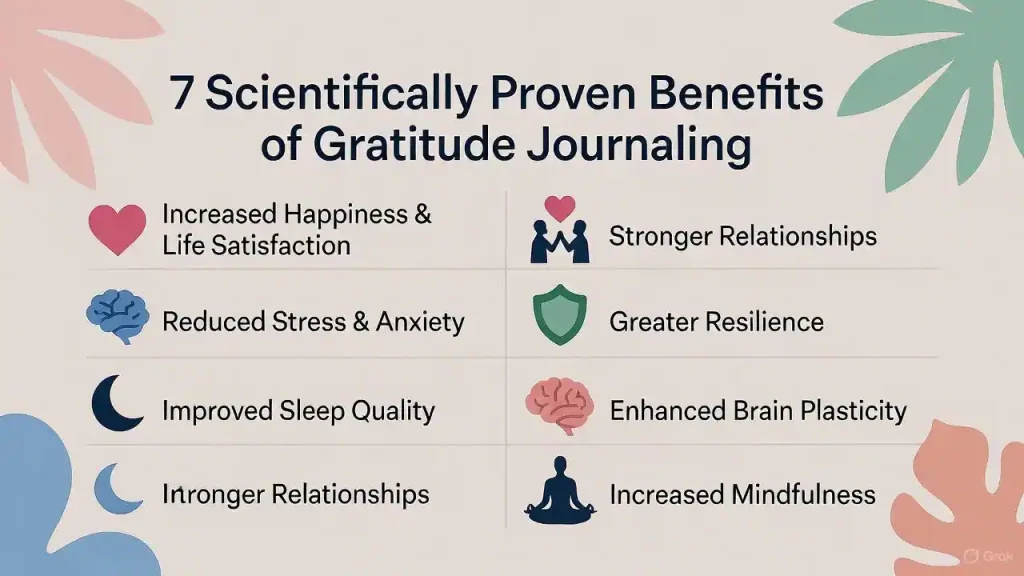
7 Proven Gratitude Journaling Benefits
Boosts Happiness
Writing gratitude daily increases baseline happiness—a concept well-supported in the psychology of gratitude. When I began noting three things I was thankful for, I noticed a subtle shift: my brain started scanning for positives instead of problems. Over time, this rewiring helped me feel joy even on difficult days. It’s not magic—it’s gratitude and brain health working together to uplift your emotional baseline.
Reduces Stress
Gratitude lowers cortisol, the stress hormone, and activates calming regions in the brain. According to studies in the psychology of gratitude, even five minutes of journaling can regulate your nervous system. I’ve felt this firsthand—on chaotic days, writing down what went right helped me breathe easier. It’s a simple yet powerful way to protect your brain health from chronic stress.
Improves Sleep
Gratitude journaling before bed reduces racing thoughts and promotes deeper rest. Neuroscience shows that positive reflection activates the parasympathetic nervous system, preparing the body for sleep. In terms of gratitude and brain health, this practice helps quiet the mind and reduce nighttime anxiety. I’ve found that gratitude is the most peaceful bedtime ritual I’ve ever adopted..
Strengthens Relationships
Expressing gratitude improves empathy, trust, and emotional connection. The psychology of gratitude explains how appreciation rewires social circuits in the brain, making us more attuned to others. When I journal about loved ones, I notice myself being kinder and more present with them. Gratitude doesn’t just heal you—it strengthens the bonds that hold you.
Enhances Resilience
Gratitude builds emotional resilience by shifting focus from what’s lacking to what’s strong. In tough times, journaling reminds you of past victories and inner resources. This is a core principle in the psychology of gratitude—it trains the brain to bounce back. From a brain health perspective, it’s like building a mental muscle for hope.
Supports Brain Plasticity
Repeated gratitude writing strengthens positive neural circuits, reinforcing optimism and emotional regulation. This is where gratitude and brain health intersect most powerfully. Neuroplasticity allows the brain to rewire itself, and gratitude is one of the most effective tools to guide that rewiring. I’ve seen this in my own life—my reactions, thoughts, and even self-talk have transformed.
Deepens Mindfulness
Gratitude journaling slows you down and anchors you in the present moment. It’s a mindfulness practice backed by the psychology of gratitude, helping you notice small joys and sensations. When I write, I’m not just listing things—I’m reliving them. This deepens awareness and nurtures brain health through intentional reflection.
How to Start Gratitude Journaling
- Choose a notebook or app.
- Write 3 things daily. Keep it simple.
- Be specific. Instead of “family,” write “my sister’s smile today.”
- Reflect weekly. Notice patterns.
- Stay consistent. Even 5 minutes a day rewires your brain.
Are you Start Journaling ? Read here details: Deep Journaling Prompts
Reflection Checklist
✅ Did I write at least 3 things today?
✅ Did I focus on specifics, not generalities?
✅ Did I notice how I felt after writing?
✅ Did I reflect on past entries?
Key Takeaways
- Gratitude journaling benefits are backed by neuroscience.
- Writing rewires the brain through neuroplasticity.
- Daily practice boosts happiness, reduces stress, and strengthens resilience.
Pro Tips
Keep your journal by your bed for nightly reflection.
Use gratitude prompts when stuck (e.g., “What made me smile today?”).
Pair journaling with mindfulness meditation for deeper impact.
FAQ
Q1: How long should I journal gratitude each day?
5–10 minutes is enough to see benefits.
Q2: Can gratitude journaling help with anxiety?
Yes, it reduces stress hormones and calms the mind.
Q3: Do I need a fancy journal?
No, any notebook or app works.
Q4: How soon will I notice changes?
Most people feel shifts within 2–3 weeks.
Q5: Is gratitude journaling scientifically proven?
Yes, multiple studies confirm its impact on brain health and happiness.

Conclusion
Gratitude journaling isn’t just a habit—it’s a science-backed practice that rewires your brain for positivity. By writing it down, you anchor joy, resilience, and mindfulness into your daily life.
What is your experience with gratitude journaling? Share your thoughts in the comments—I’d love to hear your story.